
Edge AI in production: Why predictability matters more than peak performance

Real-time systems are won on consistency and fleet health, not on peak inference speed.
Most edge AI programs start with a hardware decision: the fastest chip and the biggest model that will fit on it. But real-time operations are rarely won on raw speed. They are won by systems that respond predictably, every time, and by teams that can keep those systems reliable long after the demo ends.
Picture a machine on a production line that has to stop within a narrow window when a sensor flags a fault. The vision system looks impressive on paper: high throughput, strong benchmark numbers, and a purpose-built accelerator designed for the workload. It never misses in the demo. Then it goes into production and, under load, occasionally returns a decision a few milliseconds late. In a control loop, a late response is not simply a slower success. By the time the machine reacts, the part may have moved and the operating window may already have closed.
That is what headline performance numbers fail to capture. In real-time systems, a result must be both correct and timely. Programs often optimize for the first requirement, while the second is what can break them in production.
At the edge, latency is not simply a performance metric. It is an operational constraint. A control loop that requires a decision within a defined window does not benefit from an impressive average if responses periodically arrive after the deadline. What matters is not just how fast the system responds, but how consistently it stays within its latency budget under real operating conditions.
Jitter, worst-case latency, and deadline-miss rates therefore become critical measures alongside average response time. They reveal the tail behavior that averages can hide and the failures that can break a real-time control loop.
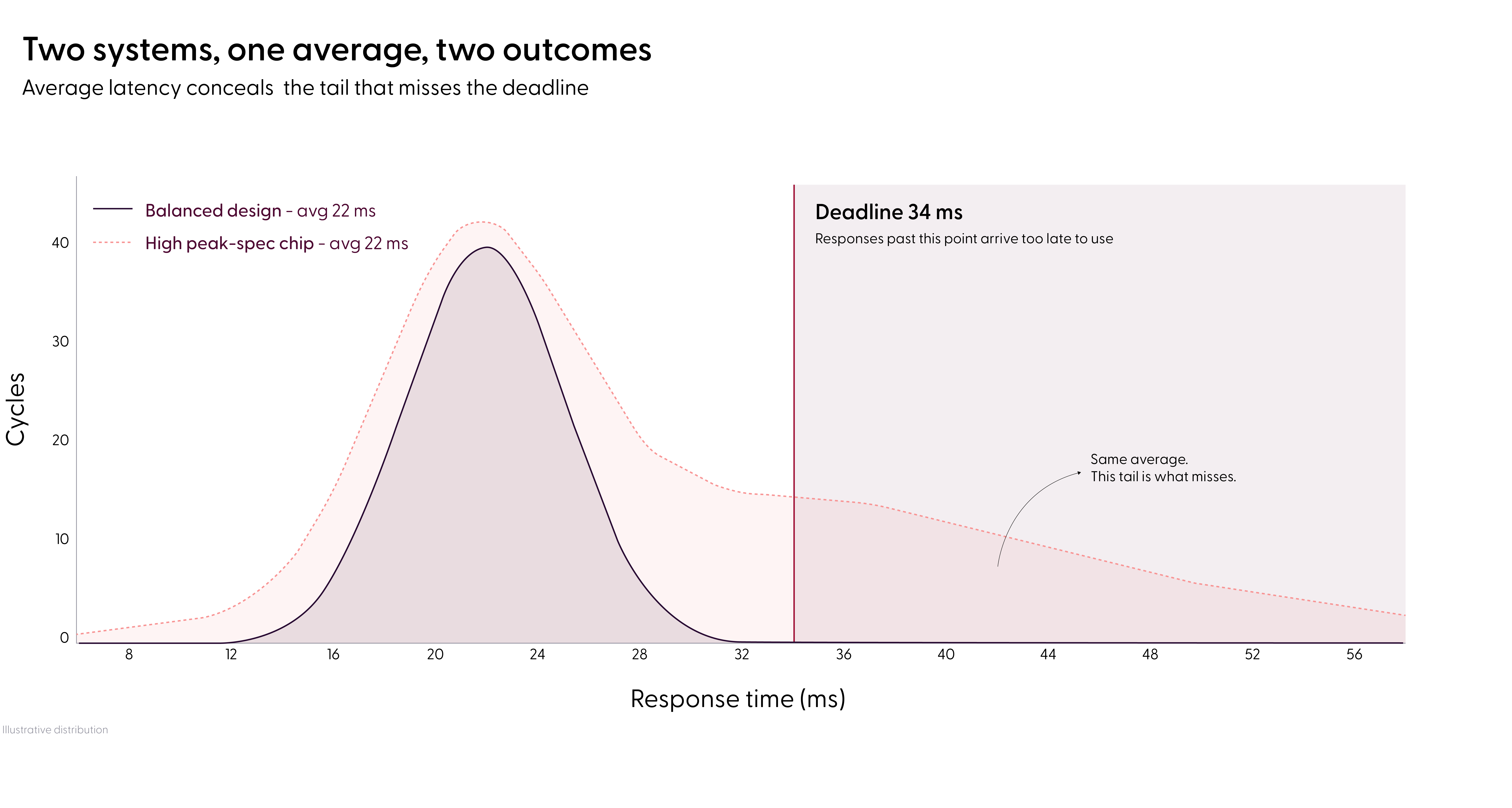
This is why headline hardware specifications can be misleading. A chip rated for a high number of operations per second may still underperform a more balanced architecture when memory bandwidth, data movement, or competing workloads become the bottleneck. Peak performance matters little if the system cannot remain predictable under sustained load, cold starts, and resource contention.
Evaluating a production edge system therefore requires looking beyond averages. Worst-case latency, response-time distributions, jitter, and deadline-miss rates provide a clearer picture of whether the system can meet its operational commitments under real-world conditions. For real-time workloads, predictable performance is often more valuable than a faster benchmark achieved under controlled conditions.
We explore the broader implications of latency in Why latency is the new competitive advantage in enterprise applications. At the edge, however, the stakes shift from user experience to operational deadlines that a control loop cannot afford to miss.
There is a tendency to treat the AI model as the whole system and to optimize it in isolation, but in practice the model is just one stage in a “perception-to-action” pipeline that must complete inside a predefined budget. Data comes in from sensors, gets synchronized and corrected, and only then reaches inference. Outputs, on the other hand, come from multiple sensors, are fused into a coherent picture, and only after that does the system act.
Every stage consumes part of the latency budget, and inference is only one contributor. Depending on the workload and architecture, preprocessing, memory movement, sensor synchronization, and sensor fusion can consume a significant share of end-to-end latency and energy.
Teams that focus exclusively on shrinking the model without understanding where time accumulates across the full pipeline risk optimizing the wrong constraint. This is why production-grade edge AI is an architecture problem, not simply a model optimization problem. The entire perception-to-action path must fit within a bounded latency budget, including its slowest realistic execution path.
Depending on the system, communication and actuation delays may also need to be accounted for within the end-to-end latency budget.
A single edge AI device is manageable. Operating thousands of them across factories, buildings, vehicles, and remote sites is a fundamentally different engineering challenge. At scale, deployment becomes a fleet operations problem.
Field devices are generally not sitting in a climate-controlled data center. They may go offline or operate over constrained and intermittent network connections. They may also operate under heat, dust, vibration, and other environmental conditions that are difficult to reproduce fully in a lab. Updates cannot simply be pushed to the entire fleet at once. Changes should roll out in controlled waves, starting with a small cohort and expanding only after device health is confirmed. Over-the-air update strategies should include cryptographic verification and a dependable rollback or recovery path when a new model, configuration, or software release causes a regression. This is the same principle we examine in shift-right quality engineering, applied to hardware that cannot be re-deployed from a laptop.
Lifecycle planning becomes equally important because industrial deployments are often expected to operate for years. Over that timeframe, hardware availability, software support, and platform consistency stop being secondary considerations and become critical to whether the fleet remains maintainable.
This is the gap teams often underestimate most: the distance between a proof of concept that works once and an operating model that works reliably across thousands of endpoints for years. The hardest edge AI problem is often not proving that a model can run on a device. It is keeping an entire fleet performant, secure, observable, and updatable throughout its operational life.
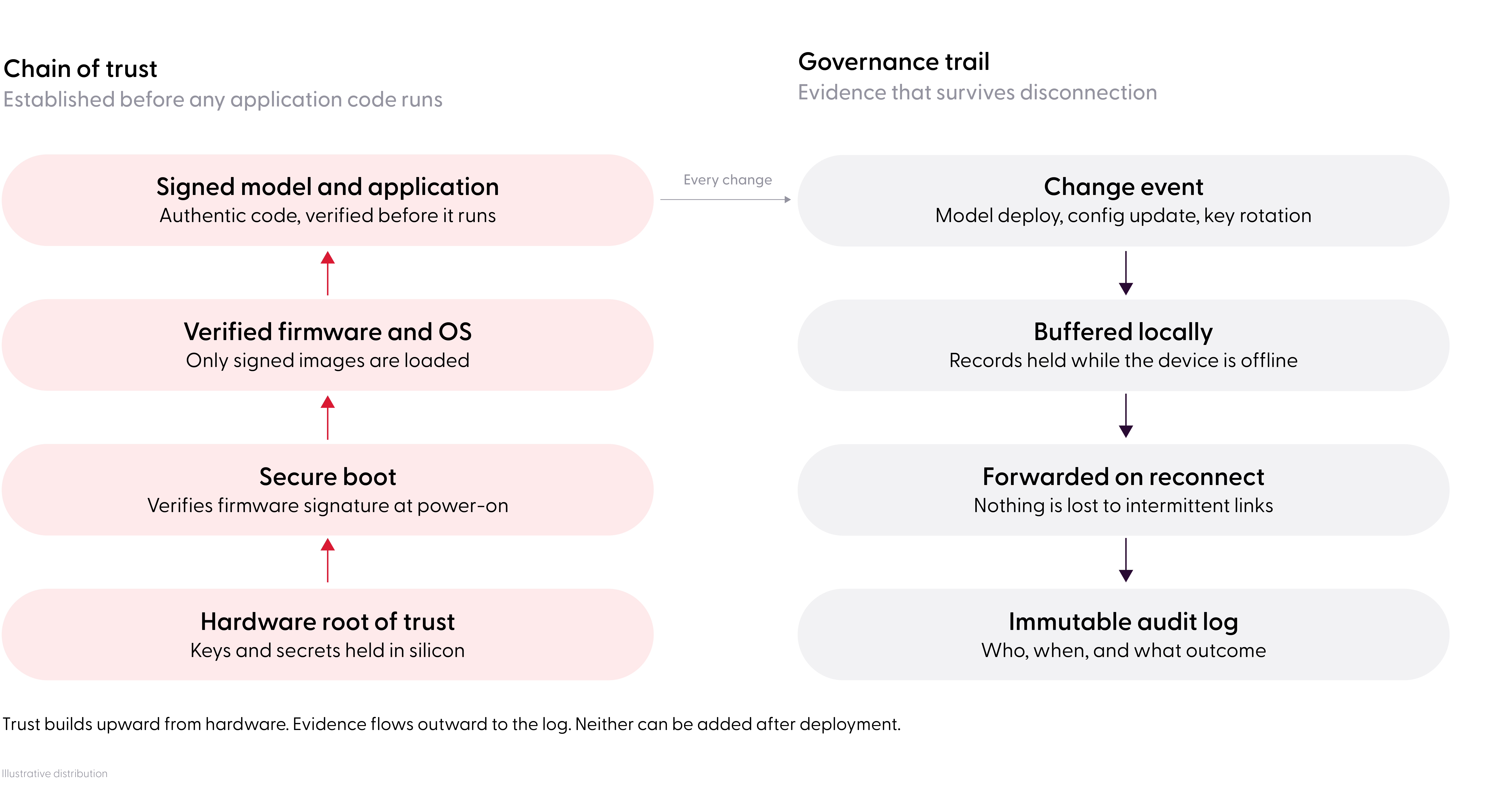
Because edge devices often operate outside controlled data-center environments, trust must be built into the stack from the start. Secure boot and verified updates establish a chain of trust so that only signed, authenticated software runs, while cryptographic keys and sensitive operations can be protected at the hardware level. In regulated sectors, these are often mandatory rather than optional.
Governance requires the same production discipline. Every meaningful change, from model deployments to configuration updates, should be captured in an audit trail. Devices can buffer records while offline and forward them when connectivity returns, preserving traceability even across intermittently connected environments. Processing data locally can support privacy and data-residency requirements. But distributing processing across devices and jurisdictions also creates more points where compliance can fail. Keeping data close to its source is therefore an advantage only when governance is designed into the architecture from the start.
Production edge AI is not an argument for abandoning the cloud. It is about deliberately deciding where each workload belongs. Time-critical inference and actions may need to remain close to the source, while the cloud provides long-term storage, model training, fleet coordination, analytics, and centralized governance. The architecture succeeds when that boundary is designed around latency, connectivity, data, security, and operational requirements rather than around a default preference for either edge or cloud.
Let’s come back to the machine on the production line. The accelerator and model were only part of the challenge. The harder problem was ensuring that the entire pipeline responded within its deadline, even under worst-case conditions, while keeping the fleet healthy, secure, and auditable long after deployment.
For enterprises moving edge AI from pilot to production, the critical question is no longer simply which model or accelerator performs fastest. It is whether the complete system can meet its latency budget consistently, remain secure and observable across a distributed fleet, and evolve without disrupting operations. Production readiness is ultimately a system-level capability.
The enterprises that master real-time operations are the ones whose systems respond predictably under pressure and whose fleets can still be trusted long after deployment. Because at the edge, the right answer comes with a deadline, and that deadline does not care how fast the chip is or how big the model is.
