
Why Clinical Handovers are an Engineering Problem, Not a Process Problem

Healthcare systems need to stop patching handover processes and start treating care transitions as connected, continuously observable information systems.
A patient moves from the emergency department to a general ward. The handing-off clinician is twenty minutes behind on documentation, the receiving nurse is managing two other admissions, and the EHR system they both use was configured by someone who left the organization several months ago. The handover happens anyway. Mostly it is fine. Occasionally, it is not, and when it is not, the consequences can be serious.
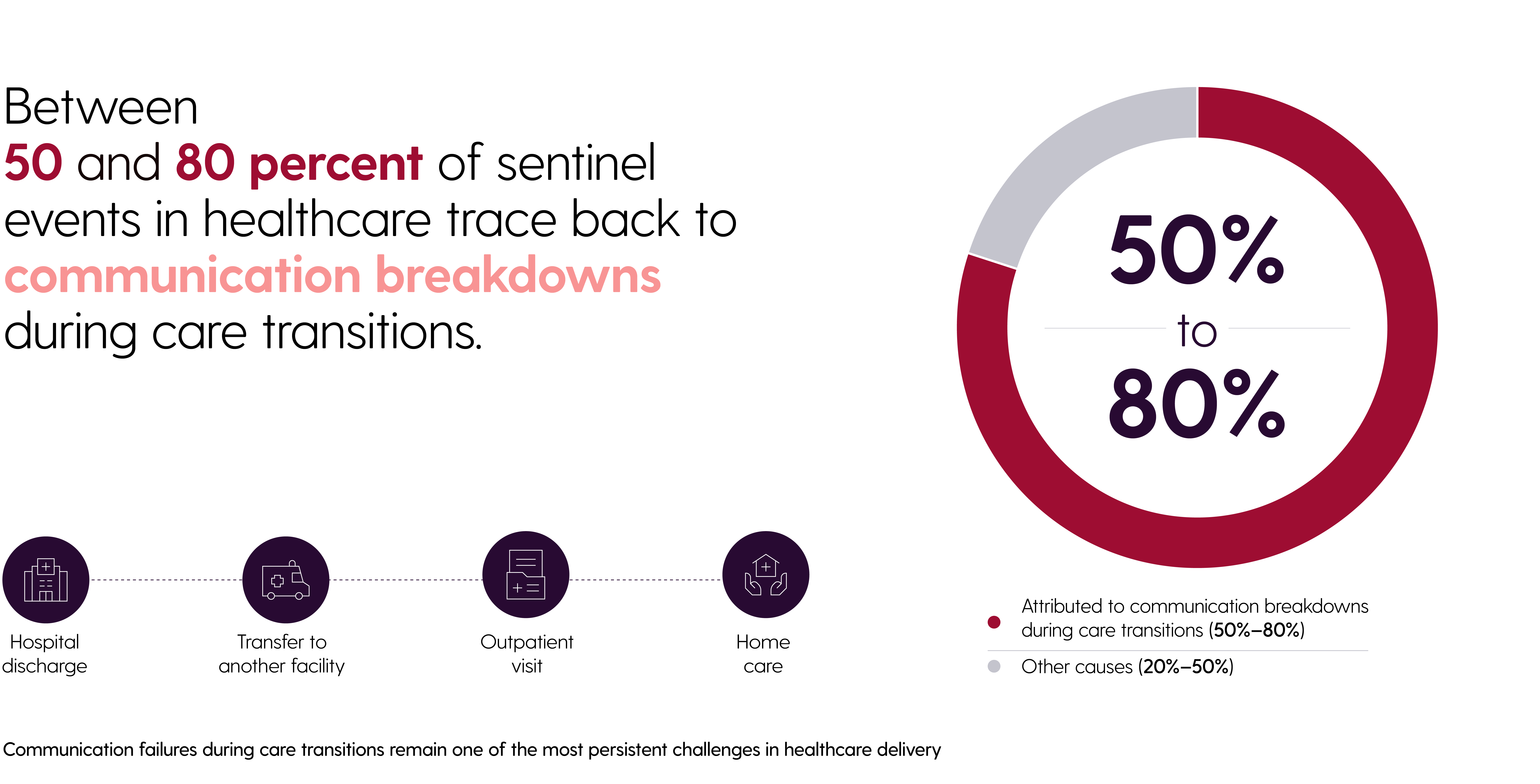
That occasional failure is not random. Between 50 and 80 percent of sentinel events in healthcare trace back to communication breakdowns during care transitions. The figure is well established and has not meaningfully shifted in years. What has definitely shifted is the volume of process interventions applied to the problem, none of which appear to be closing the gap.
The question worth asking in this scenario is why a decade of process-centered reform has produced so little on the underlying outcome.
Healthcare institutions tend to reach for process when things go wrong at the clinical handover. A new communication framework is introduced, a mandatory template gets added to the EHR, and a training module gets scheduled. These responses share a common assumption that the handover failed because someone did not follow the right steps, and that better steps will produce better outcomes.
However, that assumption rarely survives contact with the reality of how handovers happen. A clinical registrar finishing a night shift is not operating in a controlled environment where the right steps are straightforward. Instead, they are prioritizing what to say against a background of fatigue, incomplete records, and an institutional culture where challenging a senior clinician carries substantial professional risk.
When a system fails repeatedly under normal operating conditions, the failure is in the design, not in the operators. The conditions that a clinical handover must survive: time pressure, skill variation, hierarchical dynamics, and fragmented documentation, are not merely edge cases, and any solution that does not account for them is solving for a version of the problem that does not exist.
Completion rates on SBAR forms, EHR template adherence, and checklist scores capture process execution, not ‘care quality’. A handover can score perfectly on every compliance metric and still fail to transfer that one piece of information that changes what happens to the next patient.
Compliance measurement creates incentives to optimize what is being measured. Teams learn to complete the documentation, but whether it reflects the actual clinical reality, whether the receiving clinician acts on it, or whether it shapes the decisions made in the following hours, none of that is in the metric. The result is an improvement program that demonstrates progress on its own terms while the actual failure rate remains steady and shows no improvement.
What genuinely moves the outcomes is visibility into what happens after the handover itself: whether the care plan was followed, whether the escalation came in time, and whether the transition created a gap that widened before anyone noticed. Healthcare organizations that build those signals back into their improvement cycles operate on evidence, while those that rely solely on compliance rates are navigating without instrumentation and calling it governance.
The challenge is not compliance itself, but treating compliance as evidence of outcomes.
Many technologies designed to address clinical handover communication failures remain stuck in pilot programs. A further 21 percent are in early workflow integration, and only a small fraction has reached routine clinical use at scale.
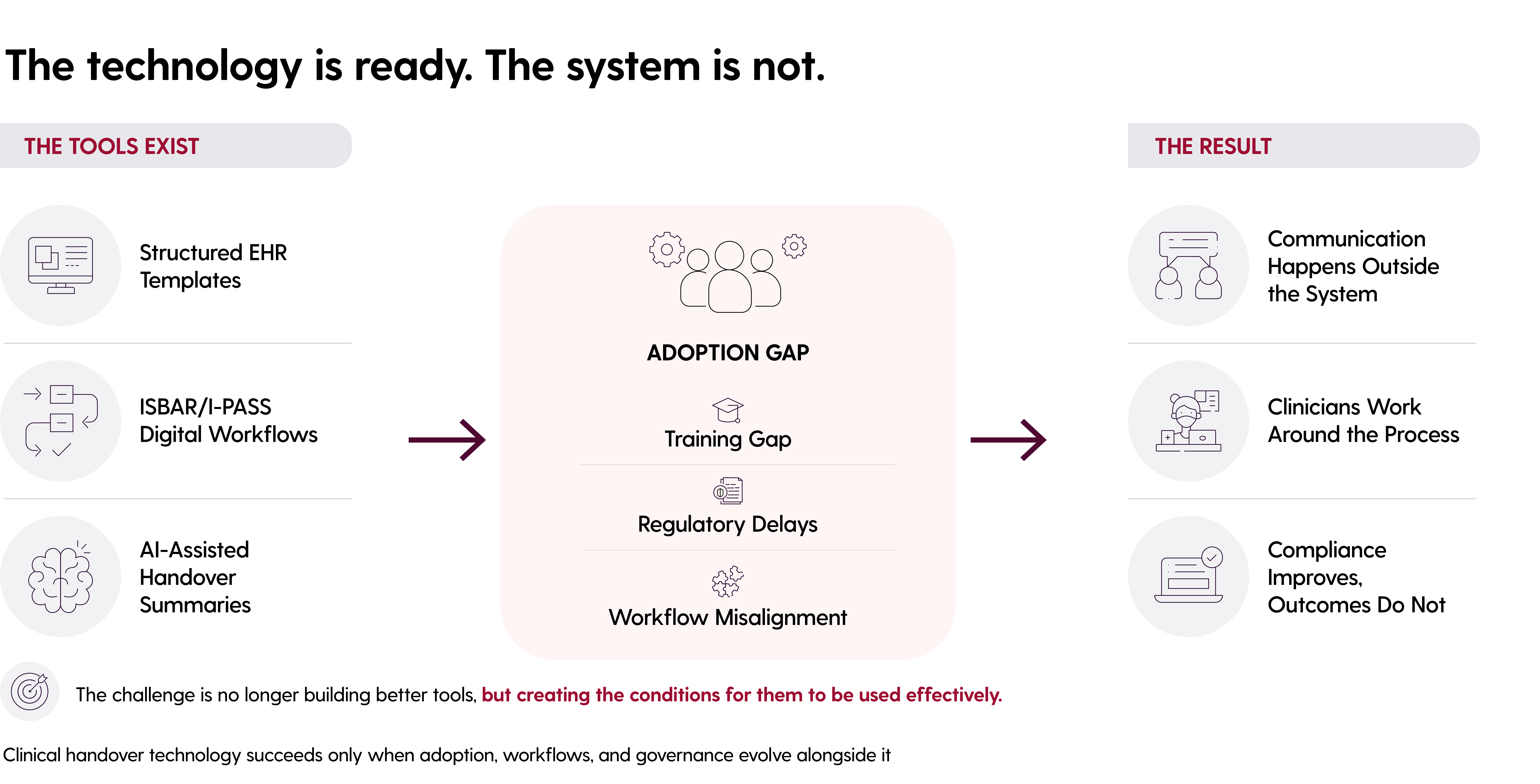
The tools that exist are technically capable: structured EHR templates, electronic adaptations of ISBAR and I-PASS, and AI-assisted summarization systems that generate handover notes from existing clinical documentation. The real bottleneck here is organizational: inconsistent adoption across sites, training infrastructure that cannot keep pace with deployment, and regulatory validation cycles under HIPAA and the EU Medical Device Regulation that clinical environments cannot wait for.
The consequence is a sector that has invested heavily in point solutions while the architecture connecting those solutions remains largely unbuilt. A handover template that clinicians work around rather than through does not reduce risk but simply adds another documentation step while communication continues outside the system, even as compliance reports suggest everything is working as intended.
The organizations where handover improvement has taken genuine hold share a different design philosophy. Rather than designing for ideal conditions, they build for the realities that actually exist: competing demands, variable skill levels, and communication cultures that protocol updates cannot reach.
Across our healthcare engagements, the challenge is rarely a shortage of structure. It is that the structure in place was never ‘stress-tested’ against operational reality. The engagements that have delivered lasting improvement are the ones that stopped treating handover as a procedure to enforce and started treating it as an information system to architect. Monitoring extended past the transition point, so anomalies surfaced early, AI-assisted tools absorbed documentation load rather than adding to it and investment in psychological safety and cross-functional trust was treated with the same seriousness as platform selection, because no technology changes what people choose to say in a hierarchy.
The organizations making meaningful progress are not simply redesigning handover forms but are redesigning the information systems that sit behind them. That shift, from process management to systems engineering, is what separates incremental improvements from lasting change.
The principle of building connected, continuously verified infrastructure rather than patching isolated vulnerabilities is one we explore in the context of healthcare systems in Zero Trust in Healthcare: The architecture that matches the threat, an argument that applies equally to information security and clinical information flow.
Structured frameworks, EHR templates, and compliance programs have been applied widely, but none of them has produced the shift in outcomes that the original problem demands.
The reframe required here is from handover as a ‘discrete procedural event’ to handover as a ‘continuous patient safety information system’, one designed for reliability under real conditions, monitored for failure, and improved through outcome signals rather than mere adherence scores.
Where that reframe has taken hold, the results are not marginal. Monitoring that is extended past the transition point catches deterioration before it becomes a crisis, AI-assisted documentation tools give clinicians time back at exactly the moment they need it most, and governance structures built around outcome data rather than compliance scores create the feedback loops that process reform never could.
Healthcare systems have spent years getting better at measuring handovers. The ones that will improve are the ones that start engineering for them instead. And in a system where the cost of a missed handover is not a failed audit but a patient who did not get what they needed, that distinction is not simply semantic.
That is the whole point.
