
Context over speed: How Playwright 1.59 is redefining test automation

Test automation has spent years optimizing for speed. More tests, faster pipelines, quicker feedback. Playwright 1.59 shifts the conversation. The question is no longer about how fast we can run tests, but how much our tests actually understand about what they are testing.
That shift may sound subtle, but it is not. Most test suites today validate whether elements exist on a page. Playwright 1.59 reflects a broader shift toward context-aware and observable test automation, supported by improvements in debugging, tracing, and extensibility. A new generation of observability tools is designed to validate whether applications are behaving the way users expect them to. That is a fundamentally different problem, and it requires a different approach within modern Playwright test automation.
This reflects a broader shift we are seeing across enterprise testing strategies, where context and observability are becoming core to reliability.
The conversation around test automation is shifting toward more context-aware and observable systems. While Playwright itself does not natively implement agent-driven protocols, the broader ecosystem is evolving in that direction.
Emerging approaches such as the Model Context Protocol (MCP) illustrate how automated systems can interact with applications in a more structured and interpretable way. Rather than relying only on DOM-level selectors, these approaches emphasize understanding user interactions in context.
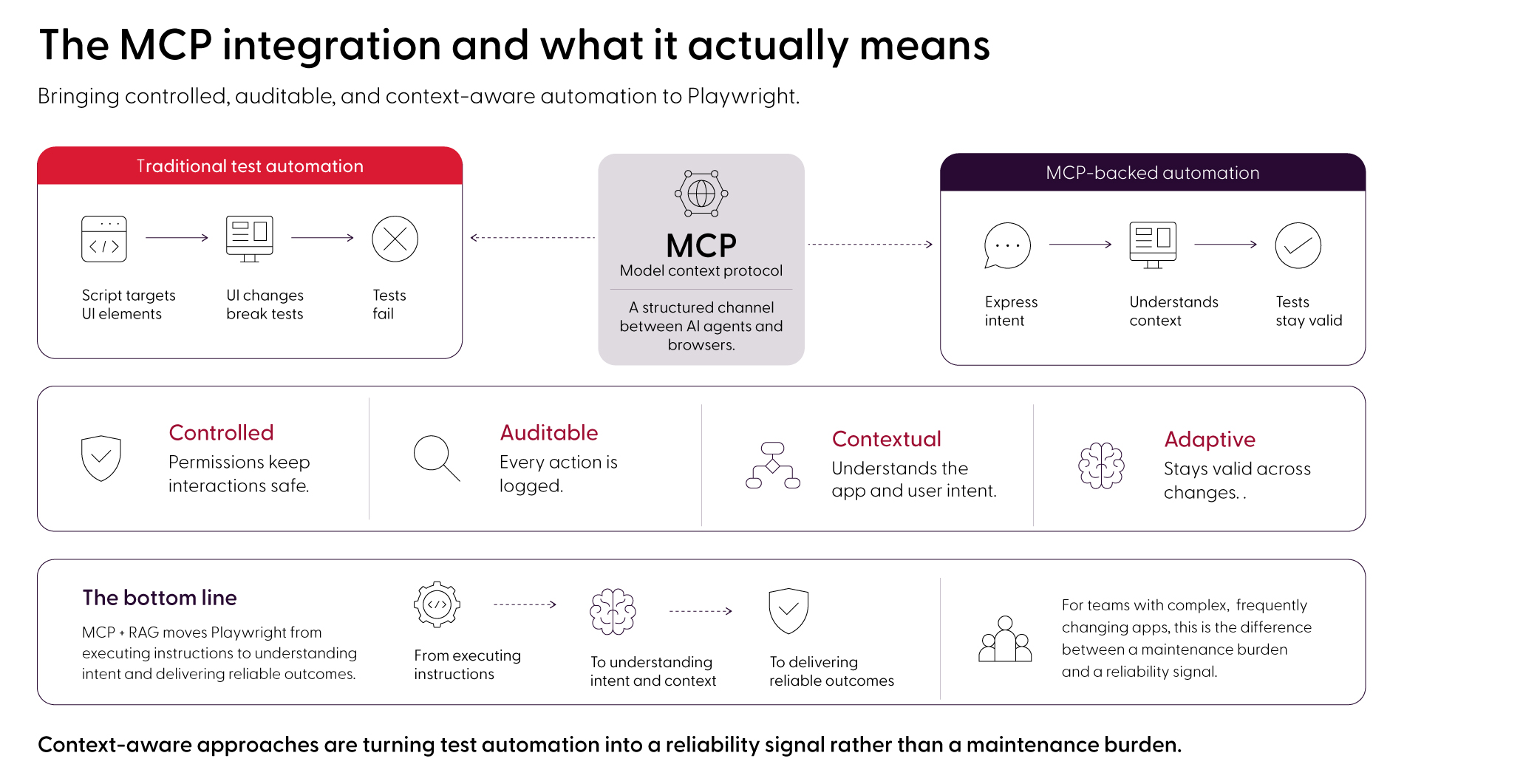
Traditional test scripts remain brittle because they are tightly coupled to specific UI states. A change in structure, naming, or layout can break tests even when application behavior remains correct. Context-aware approaches aim to reduce this fragility by validating workflows and intent rather than individual elements.
When combined with AI-assisted tooling and retrieval-based approaches, test automation can begin to incorporate richer context about application behavior. This represents a shift from executing predefined instructions to validating how systems behave under real-world conditions.
The problem is no longer how fast tests run— it's how much they actually understand.
One of the most persistent issues with automated testing is the gap between failure and the understanding of it. A red CI run tells you something broke, but it rarely tells you what actually happened, in what sequence, and under what conditions. Playwright 1.59 closes that gap with meaningful improvements to the Trace Viewer and a new Screencast API.

The new Trace Viewer lets teams group actions into logical steps and navigate test executions to understand complex end-to-end flows. Instead of scanning through a flat list of events to find where things went wrong, engineers can see exactly which part of a workflow failed and what the application state looked like at that moment.
Moreover, the Screencast API adds annotated video recordings of test runs to the picture. In a CI environment, a failing test with an attached video recording is a different debugging experience than a stack trace and a screenshot. Engineering teams can now see the sequence of events that led to the failure, which is particularly valuable for distinguishing between actual bugs, flaky infrastructure behavior, and test logic problems. Those three things often look identical in a log but look very different on video.
Debugging in testing has historically been an individual skill. Different engineers can develop different approaches, which means knowledge of how to investigate failures tends to stay siloed with whoever worked it out the first time. Playwright 1.59 introduces a CLI-first debugging approach with the --debug=cli flag that makes the debugging workflow standardized and transferable.
What that means is that when an incident occurs, any team member can follow the same investigation path. The process for reproducing, isolating, and diagnosing a failure becomes a documented workflow rather than institutional knowledge held by whoever has the most experience with the test suite, and for teams that deal with high volumes of CI failures or operate in on-call rotation, the reduction in triage time compounds quickly.
Across our engagements, this is one of the most consistent sources of avoidable delay we’ve witnessed. When an engineer can pick up an investigation and follow the same process regardless of their familiarity with the specific test suite, the overall reliability of the pipeline improves, not just the speed of individual fixes.
The new headless mode in Chromium is a less headline-grabbing change but one that will definitely matter to teams who have dealt with the classic problem of tests that pass locally but fail in CI. The gap between headless and headed browser behavior has been a source of false negatives in test results for years. Playwright 1.59 narrows that gap significantly.
Modern web applications do not behave identically across different environments. Animation timing, network conditions, rendering differences, and how browsers handle JavaScript in headless mode all contribute to test results that do not reliably reflect what users actually experience. A headless mode that more closely mirrors real browser behavior means test results in CI carry more signals and are measuring what the application actually does rather than how the application behaves in a constrained simulation of a browser.
Playwright 1.59 deepens its integration with Axe Core, the accessibility testing engine, making automated accessibility checks a native part of the testing workflow rather than a bolt-on addition. The practical implication is that teams can run WCAG compliance checks as part of the same CI pipeline that runs functional tests, catching accessibility regressions at the same point in development where they catch behavioral regressions.
It’s important to note that this integration is deliberately lightweight in implementation, and there is no global import requirement. AxeBuilder is imported directly into the test files where it is needed, which means teams can start with a single accessibility test on their most critical pages and expand coverage without restructuring their test suite.
This matters more now than it did a few years ago. Accessibility compliance is now increasingly tied to regulatory requirements in multiple jurisdictions, and the cost of retrofitting it into an application later is significantly higher than catching issues during the development process. More broadly speaking, accessibility is gradually moving from a downstream checklist to a core validation layer within the development lifecycle, a direction we’ve explored further in our article on Designing accessibility as a core digital strategy.
Selenium-based approaches are beginning to show limitations in highly dynamic environments, and while Cypress remains effective within a narrower scope, it does not completely address the demands of modern, distributed, and rapidly evolving applications. Playwright test automation stands apart by aligning more closely with what enterprise-scale testing now requires, including cross-browser reliability, deeper CI/CD integration, richer observability, and intelligence layered into the testing process itself. With a strong ecosystem and continued investment from tech giants, it is not a tool that is plateauing in maturity, but one that is still expanding its capabilities.
More importantly, this represents a shift in how teams think about test automation altogether. For many, test suites still act as a proxy for UI consistency rather than a true signal of application quality, and the gap between the two is where most instability, flakiness, and debugging overhead originates. What Playwright 1.59 enables is a move beyond that gap, toward tests that understand context, failures that are explainable, and systems that evolve alongside the application rather than constantly breaking against it.
Most will continue operating with legacy approaches until complexity forces a change. But by that point, the cost is already visible in unreliable pipelines, delayed releases, and time lost diagnosing issues that should have been self-evident.
The real inflection point is not when complexity arrives, but when teams choose to get ahead of it. The difference is simple: evolve by design or be forced to react when it is already too late.
Test automation is no longer about validating UI states. It is about validating system behavior in context.
