
Enterprise AI at Scale: Why Execution Determines ROI

Artificial intelligence is moving rapidly from experimentation to enterprise infrastructure.
AI is no longer confined to pilot programs or isolated analytics initiatives. It is now embedded across customer engagement, operations, risk management, software engineering, and decision support through an expanding range of intelligent systems.
Yet despite rising investment and widespread deployment, sustained return on investment remains uneven.
Performance, infrastructure, and data access have advanced rapidly. Large-scale deployments now show that ROI is determined less by model sophistication and more by how effectively intelligent systems are integrated into core workflows and decision-making.
Enterprises are investing heavily in generative and agentic AI systems, embedding intelligence into platforms and operations at unprecedented speed. Returns, however, have not scaled at the same pace.
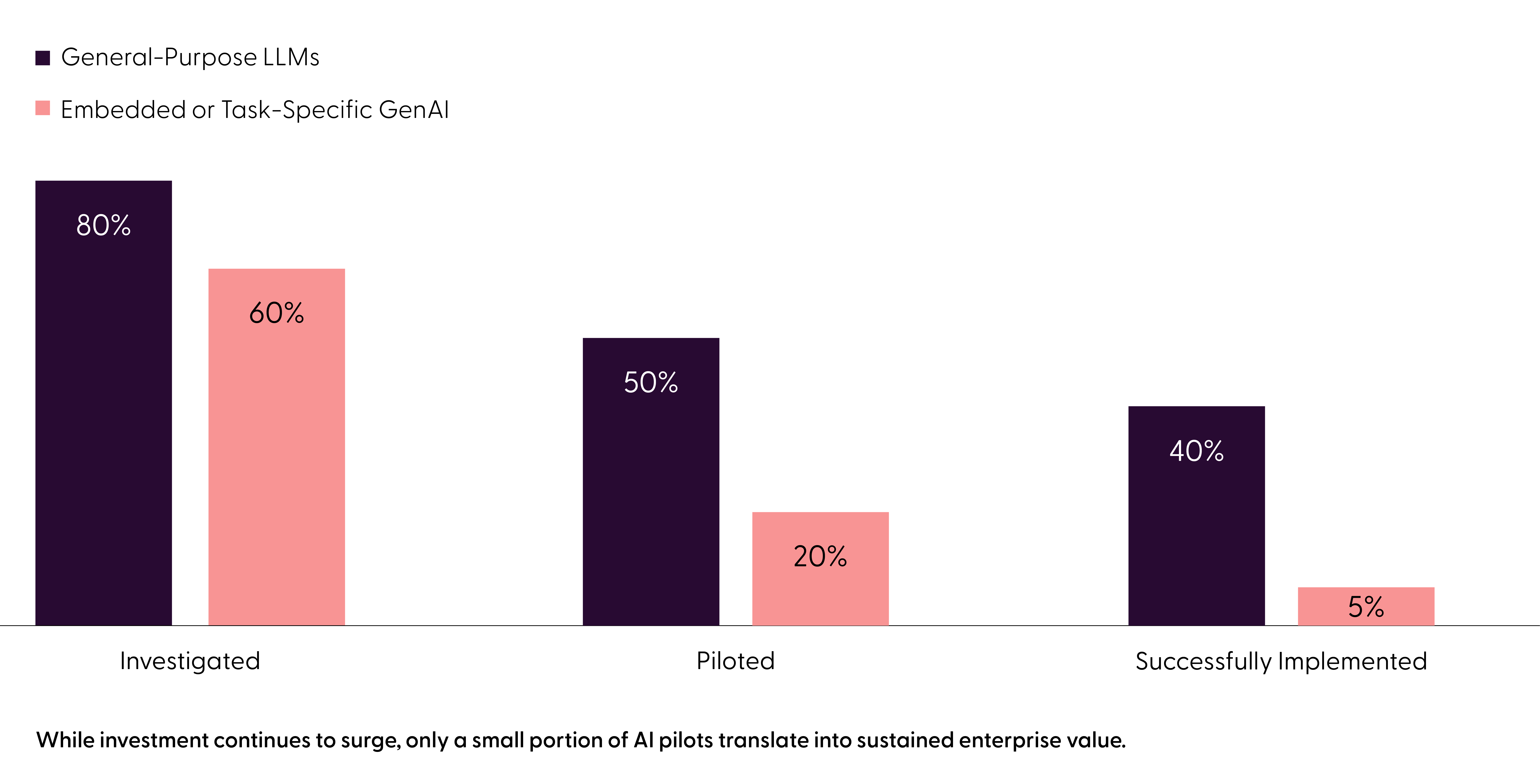
Industry studies suggest that a large majority of enterprise AI pilots struggle to deliver measurable ROI or material P&L impact. Only a small fraction ultimately translates into sustained enterprise-level value.
Adoption is widespread. Investment is accelerating. Yet value creation remains concentrated among organizations with strong execution discipline.
AI initiatives rarely fail at proof-of-concept. Early pilots typically demonstrate technical feasibility, productivity gains, and executive sponsorship.
The breakdown typically occurs when AI must scale across functions and integrate into core business workflows.
Common execution barriers include:
Most initiatives fail not because models underperform, but because intelligent systems are deployed without alignment to operating models, accountability structures, and incentives.
As complexity increases, responsibility diffuses, trust erodes, and ROI plateaus.
AI is no longer confined to isolated tools. Organizations are deploying interconnected systems that orchestrate workflows, trigger decisions, and adjust operations in real time.
Early adopters are achieving measurable returns through faster cycle times, reduced manual intervention, and improved coordination across complex processes.
Autonomy, however, amplifies risk when escalation paths, oversight mechanisms, and dependencies are unclear.
AI magnifies organizational strengths as well as weaknesses. Where execution discipline exists, returns accelerate.
This shift toward operationalized intelligence aligns closely with insights from our whitepaper, Best practices for integrating Generative AI into digital engineering projects, where we examine how governance, workflow design, and execution models enable sustained business outcomes.
Early AI business cases focused heavily on automation and cost reduction.
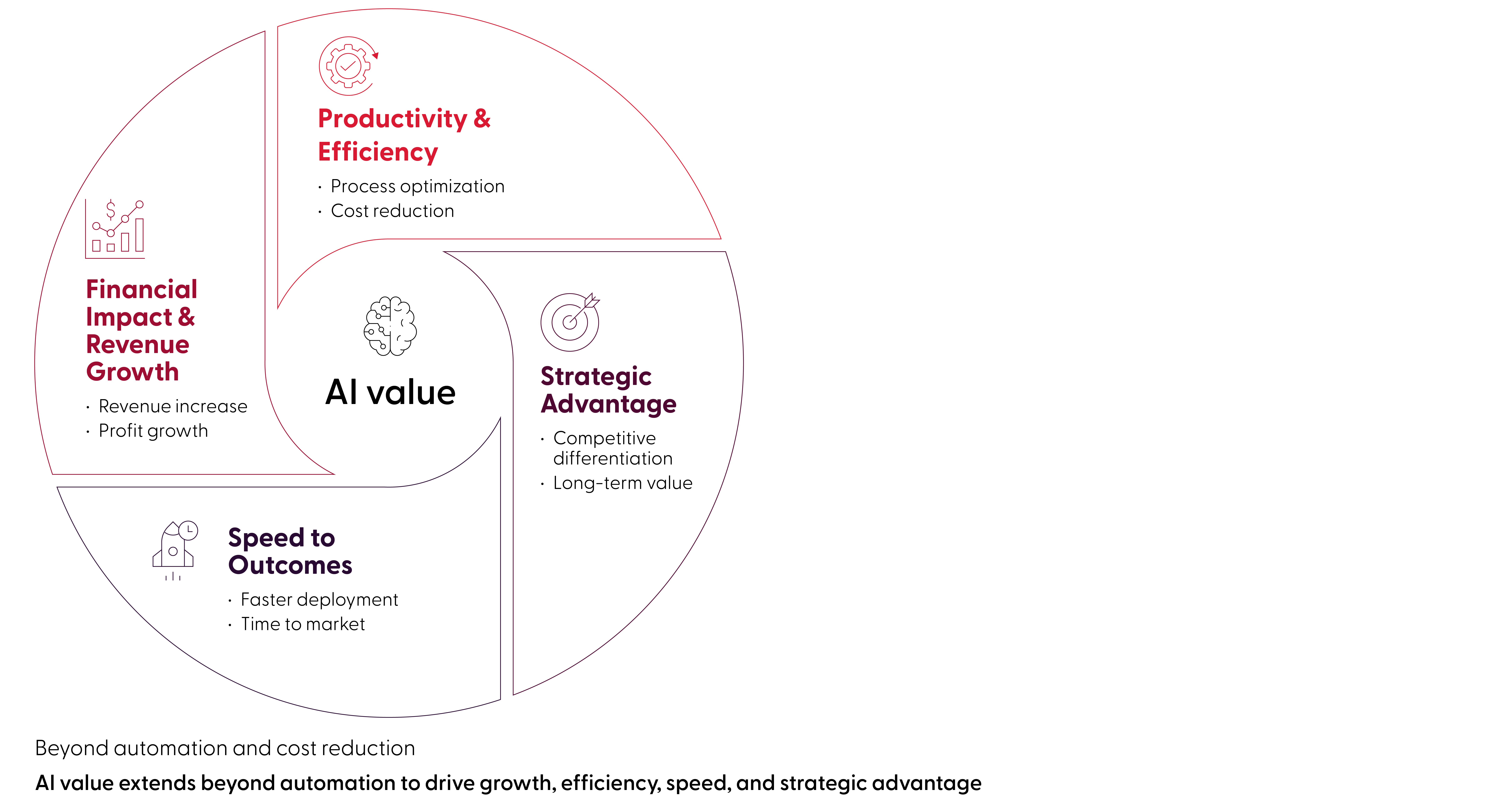
Large-scale deployments show that AI value is multidimensional, spanning:
Only a small group of organizations consistently achieve sustained returns across these dimensions, driven by execution maturity rather than technology adoption alone.
As AI increasingly shapes decisions and outcomes, AI governance becomes foundational to value creation.
Security, explainability, accountability, and auditability are no longer compliance considerations alone. They are prerequisites for scaling intelligent systems with confidence.
Organizations that attempt to retrofit governance after deployment struggle to keep pace with automation.
In contrast, those that embed AI governance directly into architectures and workflows accelerate adoption while managing risk effectively.
Organizations achieving sustained AI ROI consistently demonstrate:
Organizations that struggle often accumulate execution debt through fragmented initiatives, disconnected platforms, and oversight gaps.
Innovation creates momentum. Execution maturity determines returns.
We support enterprises in moving beyond AI experimentation by designing execution-ready operating models, embedding governance by design, and scaling intelligent solutions across business functions to unlock sustained value.
AI’s ability to create value is no longer in question.
Large-scale deployments now make one reality clear: AI does not generate ROI in isolation. Value emerges when enterprise AI solutions are embedded into operating models, governed intentionally, and executed with discipline.
Organizations that continue to treat AI as a series of disconnected initiatives will likely see fragmented impact but those who design for scale, accountability, and trust from the outset will move beyond experimentation and begin to compound value.
In the next phase of enterprise AI adoption, competitive advantage will depend less on who deploys AI first and more on who operationalizes it most effectively.
That is where lasting returns are earned.
