
Low-code as core infrastructure for intelligent applications

For years, the gap between what businesses need and what technology can deliver has been the defining friction in software development. Low-code has changed that equation. The question now is whether organizations are using it strategically enough to realize that potential.
Most software projects don’t fail at the idea stage. They stall in the translation between business demand and technical execution within the required timelines and resource constraints. Traditional development demands large teams, extended planning cycles, and sequential handoffs that create friction at every stage. The result is a persistent gap that compounds over time.
Low-code development platforms are a mainstream response to that gap. Through visual interfaces, drag-and-drop tooling, and pre-built components, they allow both developers and domain experts to build functional applications without writing everything from scratch. AI-assisted logic generation, workflow recommendations, and automated integrations are further accelerating development while shifting how capacity is distributed across the organization and who participates in the development process.
Traditional development cycles typically run three to twelve months, while low-code platforms can compress that to weeks or, in some cases, even days. Industry data consistently shows significant reductions in development timelines, often measured in weeks instead of months, and AI is compressing those timelines even further.
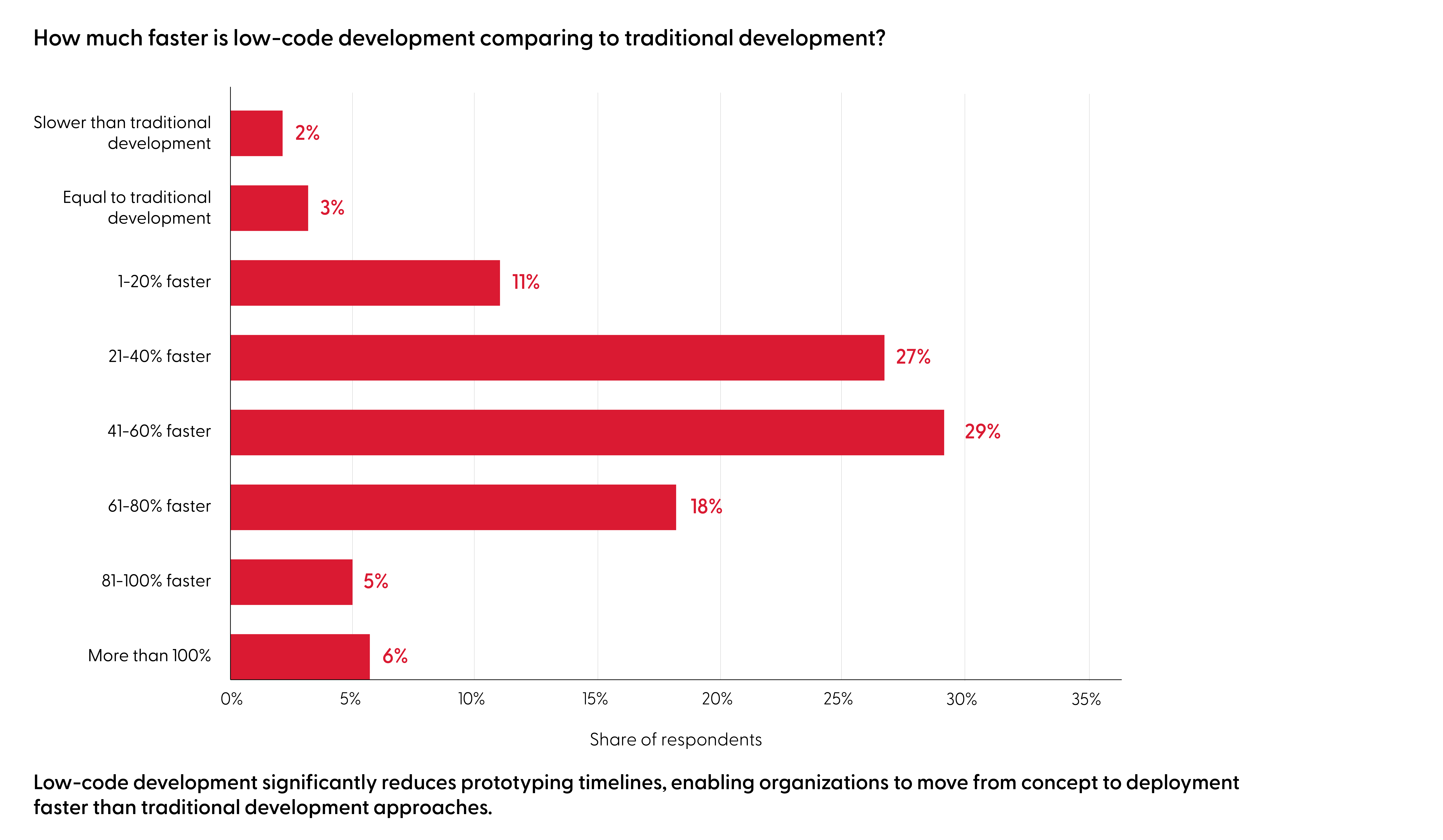
Three factors are contributing to this shift:
New markets, shifting user expectations, and evolving regulations make long development cycles increasingly costly. Low-code provides a shared platform for faster, more coordinated responses. Through intelligent code generation, automated workflow suggestions, and predictive logic, prototyping cycles are being cut by an additional 40-50 percent.
Analysts, operations teams, and domain experts can now create the solutions they need themselves, reducing IT backlogs. AI-assisted tooling is extending this further, enabling non-technical users to build increasingly sophisticated applications and making the productivity gap between skilled developers and business users narrower than it has ever been.
A prototype launched in weeks can be improved against real user feedback in days. Behavioral analytics, embedded in modern platforms, are turning feedback loops that once required manual analysis into continuous, system-generated signals.
The convergence of AI and low-code is also laying the groundwork for more autonomous systems, a direction we explore in depth in our article on AI-driven self-healing systems.
One of low-code’s most under-discussed advantages is its impact on collaboration.
Because the development environment is accessible to non-technical users, business and IT teams can work inside the same process rather than across it. This shared ownership reduces miscommunication, accelerates decision-making and begins to dissolve the handoff culture that has historically slowed delivery at every stage.
Low-code is not accelerating development; it is fundamentally changing how quickly ideas move from business demand to working applications.
Across our engagements, we consistently see low-code platforms reduce friction beyond just speed. Teams that previously waited weeks for IT response cycles are iterating independently. Product ownership has become more distributed, and adjustments happen closer to the point of demand.
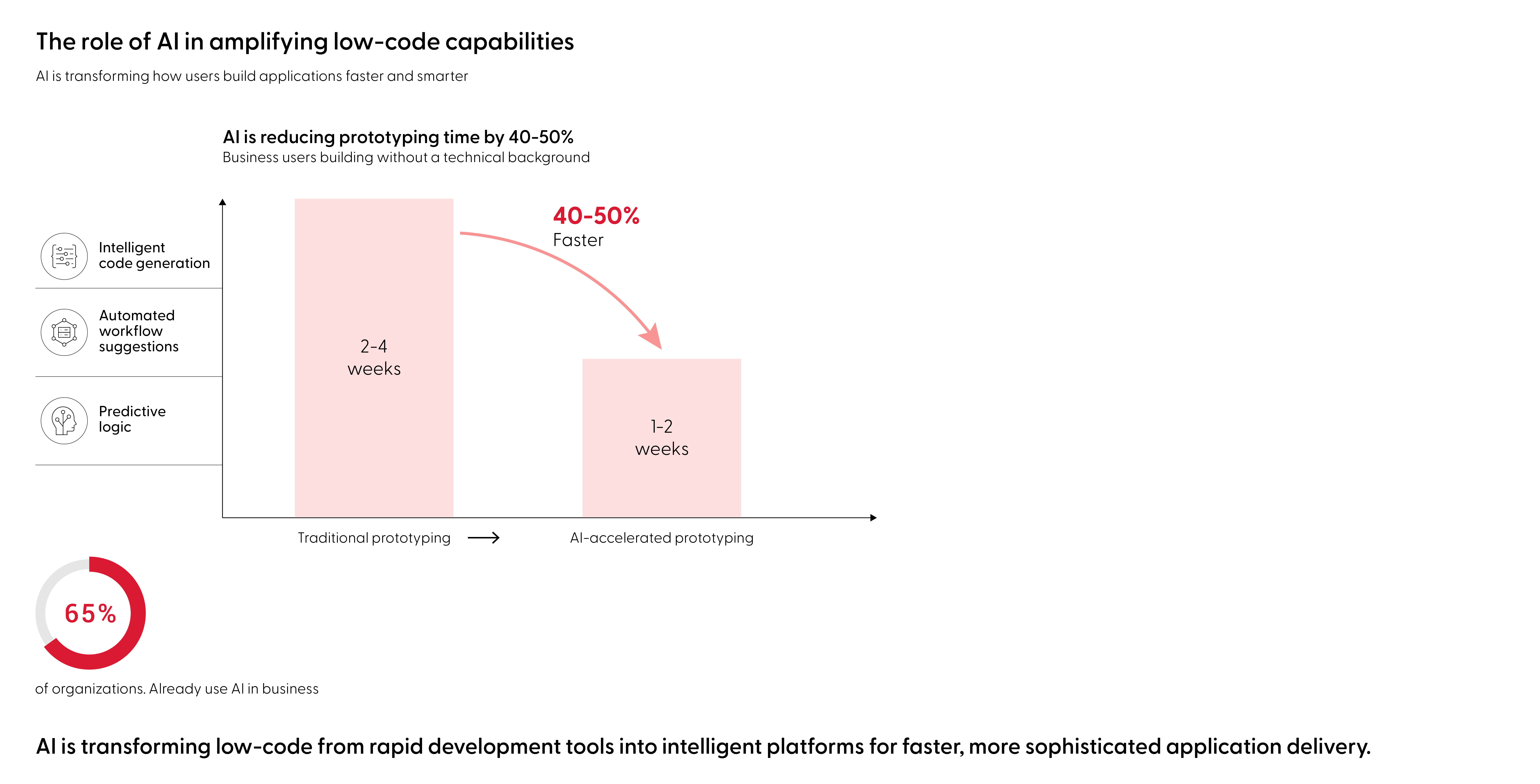
As AI adoption accelerates, low-code platforms are becoming a critical layer in enabling faster, more adaptive application ecosystems.
The collaboration benefit is also where AI is adding the most nuance: when both business and technical users are working on shared low-code platforms with AI-assisted tooling, the review and validation cycles that once required specialized expertise are becoming faster and more accessible, without reducing quality.
Low-code is not a universal answer. Organizations that treat it as one will eventually hit a ceiling they did not anticipate.
Customization has hard limits. Low-code development platforms are effective at covering the majority of use cases, but complex business logic and highly specialized requirements can exceed what the platform can support. The solution is to stop pitting it against traditional engineering. The two work better together than either does alone, and organizations that treat them as competing choices can run into constraints that a more balanced approach would have avoided.
Scalability requires planning upfront. A tool that works well for early-stage builds can start showing strain as applications scale to more users, integrations, and data. Decisions made quickly in the early stages often become constraints later, and AI-generated components require the same architectural scrutiny as hand-coded ones.
Security cannot be retrofitted. Because low-code is designed for accessibility, governance, access controls, and compliance are often deprioritized in early builds. In our engagements, we push back on that instinct early, embedding security and data governance requirements before the first component is deployed because the cost of adding it later is almost always higher than the cost of building it in.
Total cost of ownership matters more than entry pricing. Licensing, vendor lock-in, and migration costs accumulate in ways that are not visible during the initial evaluation. The most affordable platform to get started on is rarely the most cost-effective one to grow on.
The conversation has moved. It is no longer about whether to adopt low-code, but it is about how to scale it without creating the fragmentation, security gaps, and technical debt that unchecked adoption produces. Organizations that will capture the most value are those that treat low-code not as a tool, but as a governed platform for distributed innovation.
That means standardized practices, clear ownership models, robust integration strategies, and the kind of architectural discipline that keeps speed from outpacing the governance framework. It also means treating AI augmentation not as a separate workstream but as a built-in property of how the platform operates, because the ones that will define the next phase are already embedding AI at the core, not on the edge.
The real advantage today lies not in building faster, but in building the right applications consistently, securely, and at scale while retaining the flexibility to evolve as business needs change.
