
The hidden cost of AI: Why sustainable infrastructure is the next strategic battleground

We have spent years celebrating AI. In the process, we have quietly built one of the most energy-intensive infrastructures in history.
AI has long been positioned as a force for solving climate change, optimizing energy grids, advancing carbon capture, and predicting extreme weather. And that may well be true. But in doing so, we built an infrastructure with unprecedented power demand to sustain it.
This paradox is becoming increasingly difficult for technology leaders to ignore.
Artificial intelligence may feel abstract, but every AI system ultimately runs on physical infrastructure. Rows of servers, buildings the size of factories, and cooling systems designed to manage enormous thermal loads.
According to the International Energy Agency, data centers already consume roughly 1–2% of global electricity demand. That number may sound modest until we consider how quickly it is rising and why. Much of that growth is now tied directly to rising AI data center energy consumption as generative models scale across hyperscale infrastructure.

Training a single large-scale AI model can consume hundreds to thousands of megawatt-hours of electricity. But training is only part of the story. Once deployed, models run continuously to serve billions of inference requests, turning energy consumption into an ongoing operational load.
Cooling alone can account for 30–40% of a data center’s total power consumption. Modern AI clusters generate so much heat that traditional air cooling is increasingly inadequate. These are no longer server rooms, but industrial-scale thermal management operations. This is no longer an infrastructure detail. It is a design constraint.
For enterprises investing in AI-led digital transformation, this means infrastructure architecture must evolve alongside AI capabilities.
AI may feel digital, but its constraints are deeply physical.
For years, data center efficiency was primarily an engineering concern; something handled quietly by infrastructure teams.
That is no longer the case.
Three shifts have pushed AI infrastructure squarely into the executive agenda:
Electricity is now one of the largest operating expenses for hyperscale computing environments. As AI adoption accelerates, rising AI data center energy consumption is beginning to transform the economics of digital transformation itself.
What was once an IT optimization problem is now a strategic infrastructure decision discussed at the CFO and CIO level.
AI economics are now directly tied to energy economics.
Governments are tightening climate disclosure requirements and energy reporting standards. Operating energy-intensive AI systems without a credible sustainability strategy is becoming both a regulatory risk and a reputational liability.
Customers, investors, and procurement teams increasingly expect clear answers:
Organizations that cannot respond with clarity risk falling behind as scrutiny around the environmental impact of AI intensifies. Transparency is no longer optional. It is becoming a baseline expectation.
The encouraging shift is that the technology to build more sustainable AI infrastructure is advancing rapidly.
New generations of AI chips are delivering dramatically higher compute per watt, improving efficiency with every hardware cycle. Specialized accelerators and optimized architectures are reducing the energy required for large-scale workloads.
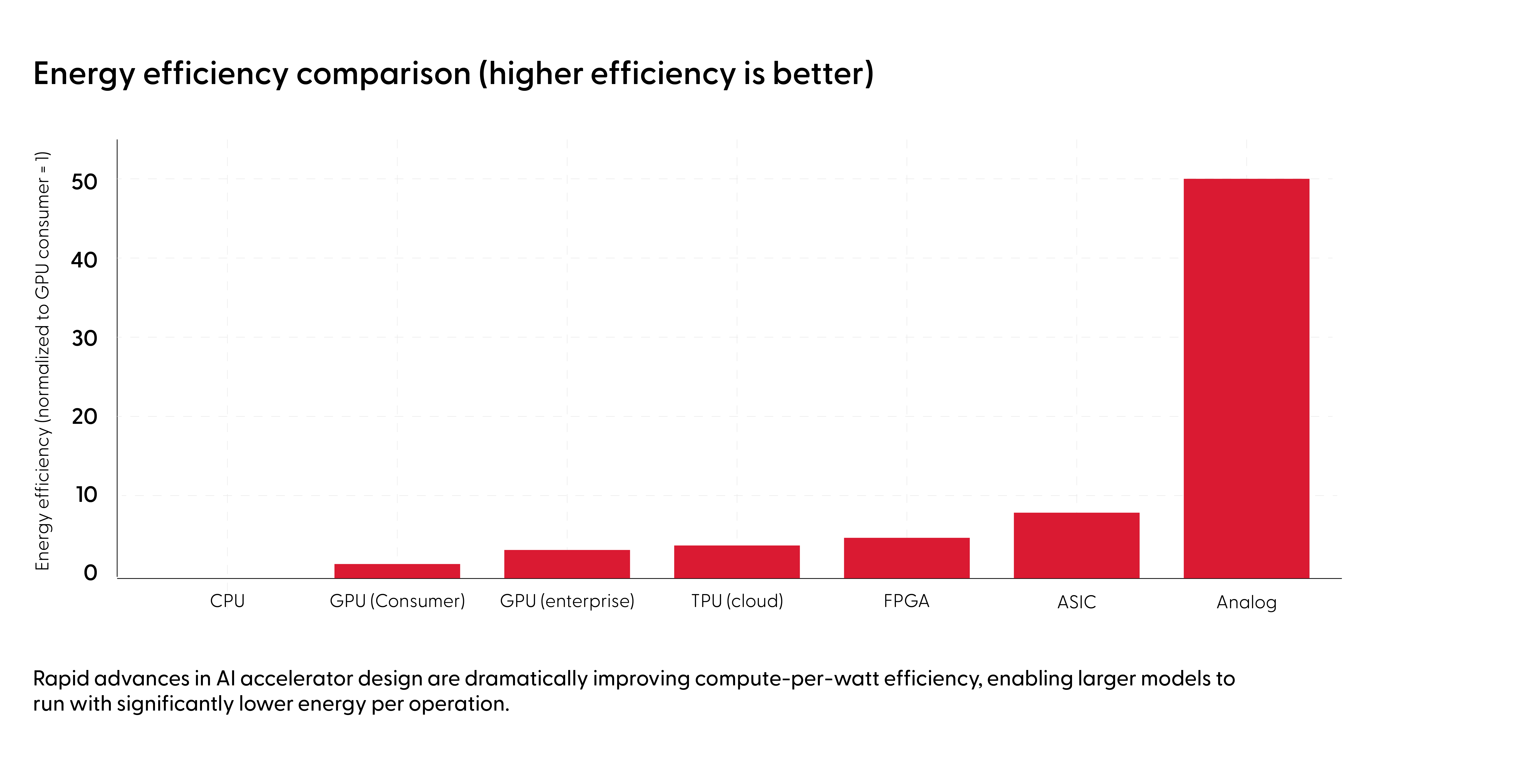
Cooling systems are evolving as well. Liquid cooling and immersion cooling technologies are replacing traditional air-based systems in high-density AI environments, improving heat transfer and reducing overall power consumption.
At the same time, many operators are integrating renewable energy procurement directly into data center strategy, rather than treating sustainability as an afterthought. Long-term power purchase agreements with wind and solar providers are becoming standard practice for large infrastructure operators.
And perhaps most interestingly, AI itself is now being used to optimize the infrastructure that powers it.
Machine learning systems can dynamically adjust cooling, energy distribution, and workload scheduling in real time, delivering measurable efficiency gains.
While this may sound recursive, early implementations have already shown meaningful improvements in efficiency.
AI strategy and infrastructure strategy can no longer evolve separately.
Organizations that treat efficiency as an afterthought will struggle to scale. The leaders are rethinking architecture itself:
In this model, efficiency is not optimization. It is architecture.
This shift toward autonomous infrastructure management is already emerging and has been discussed in further detail in our article on AI-driven self-healing systems, which can monitor performance, detect anomalies, and automatically correct failures to maintain resilience.
The infrastructure question is the AI question. Scale is no longer just about models. It is about the systems that power them.
Infrastructure is rapidly becoming one of the defining constraints of large-scale AI adoption.
Every model, every automated decision, every generative workflow runs on physical machines in physical buildings, consuming real electricity. The intelligence is virtual, but the power bill is not.
Industry estimates suggest that AI-driven workloads could significantly expand global data center electricity demand over the next decade.
For many organizations, the ability to scale AI will increasingly depend not only on algorithms, but on whether their infrastructure strategy can sustain that scale efficiently and responsibly.
The organizations that solve this challenge early will not only reduce environmental impact; they will gain a structural advantage in operating costs, scalability, and long-term credibility.
Artificial intelligence promises smarter systems and faster decisions.
But the defining challenge of the AI era is not just intelligence. It is how sustainably that intelligence can be powered.
The organizations that will lead are not only building better models. They are building better infrastructure.
The question is no longer how fast you can scale AI.
It is how efficiently, responsibly, and sustainably you can sustain it.
