
Navigating the Megatrends Transforming Enterprise Strategy in the Age of AI

Most Digital Transformations don’t fail because of outdated technology; they fail because leadership continues to ask 20th-century questions with 21st-century tools.
Never before has so much been invested in digital transformation, yet delivering meaningful impact often feels more difficult than expected.
Cloud platforms are live. AI pilots are scaling. Sustainability roadmaps are published. Workforce programs are underway. Yet productivity remains flat, and the competitive distance remains unchanged.
The issue is not ambition but the growing complexity of the world in which these transformations must succeed.
For the first time in modern business history, multiple structural forces are transforming enterprise strategy simultaneously: artificial intelligence, workforce transition, geopolitical realignment, demographic change, and sustainability pressures.
These forces do not move in parallel. They interact, amplify one another, and create nonlinear effects. Linear strategy in a nonlinear world is one of the primary reasons transformation stalls.
AI does not create capability. It exposes it.
Organizations with clear processes, high-quality data, and fast decision cycles gain acceleration. Those without them simply automate complexity at scale.
The companies generating the greatest returns are not those deploying the most advanced models, but those that understand their operations end-to-end and treat data as core infrastructure.
The defining leadership question is no longer:
“How do we implement AI?”
It is now: “What do we understand well enough to automate, scale, and continuously improve?”
That distinction determines whether AI becomes a multiplier of value or a multiplier of existing friction.
As automation absorbs routine execution and AI supports real-time decision-making, human effort shifts toward creativity, judgment, and complex problem-solving.
Value will be measured less by hours worked and more by the speed of innovation and the quality of decisions.
By 2030, most enterprise roles will be affected by AI and advanced technologies.
But capability is not built through periodic training programs. Organizations that succeed will embed learning directly into everyday work and build cultures where people evolve with technology rather than being disrupted by it.

The highly integrated global economy of recent decades is giving way to a more regionally aligned and strategically influenced landscape.
Industrial policy, regulatory divergence, and technology sovereignty are redrawing trade flows and investment priorities.
Cost efficiency alone is no longer the dominant objective. The ability to absorb shocks, rebalance sourcing, and operate across multiple regulatory environments is becoming a requirement.
Strategic success now depends on balancing global scale with local responsiveness and accelerating the shift toward modular, cloud-enabled operating models. This is an approach we explore further in our whitepaper on Azure-powered transformation.
Population dynamics are transforming both markets and the workforce.
Aging economies are increasing demand for healthcare, financial security, and assistive technologies, while younger, digitally native populations are accelerating consumption and digital adoption.
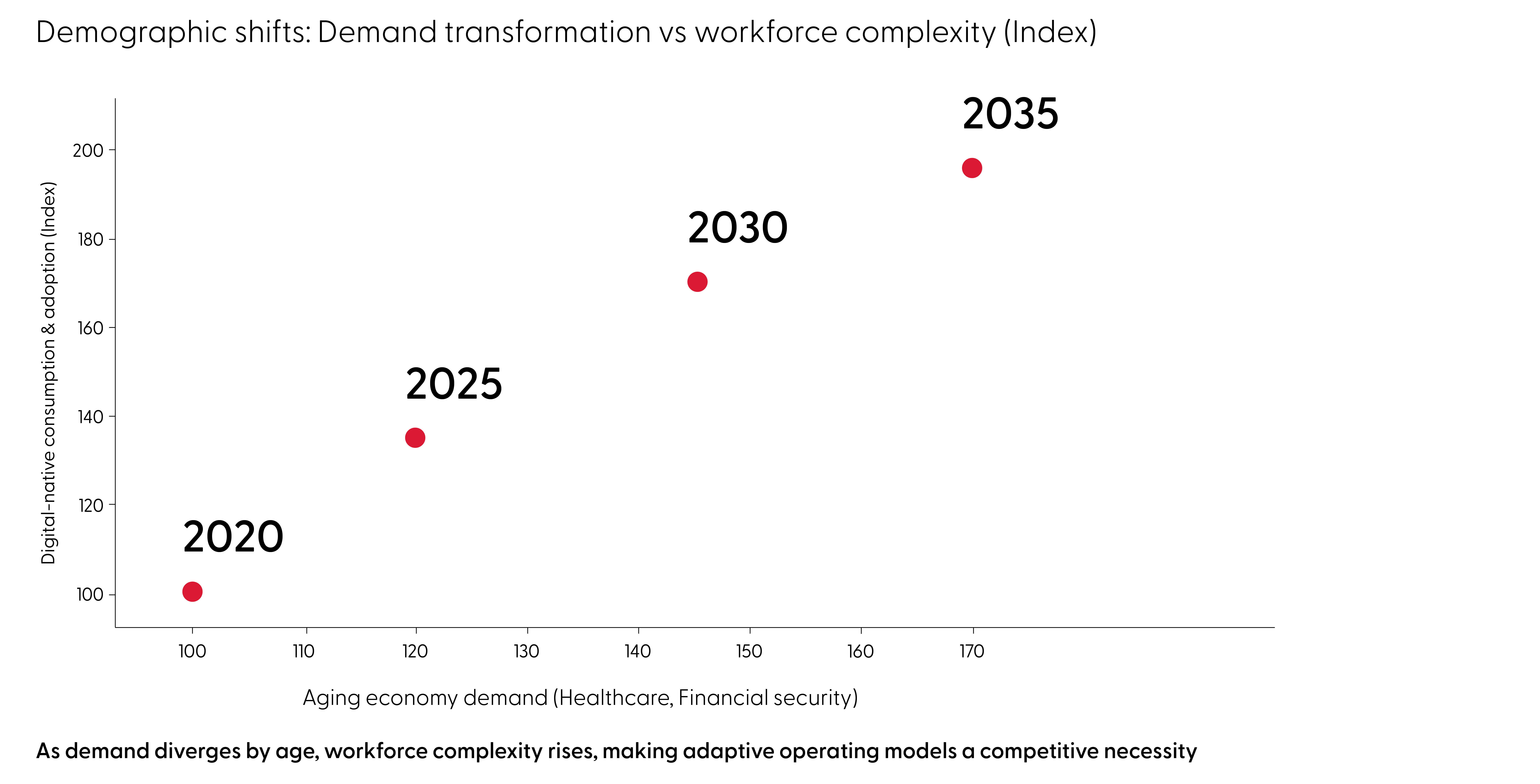
At the same time, multiple generations now coexist in the workplace, each with different expectations around flexibility, purpose, and career development. Organizations that evolve leadership, culture, and work models accordingly will be best positioned to attract and retain high-value talent.
Environmental and social responsibility has moved from the margins of business to the center of enterprise strategy.
Climate risk, resource constraints, regulatory pressure, and stakeholder expectations are forcing organizations to rethink how they operate.
Energy efficiency, optimized material use, and circular value chains are not only reducing emissions; they are lowering structural costs, limiting long-term exposure, and strengthening innovation capacity. What was once viewed as compliance is becoming a source of durable competitive advantage.
Risk is now multidimensional, with disruptions cascading across value chains in real time. Cyber threats, climate events, geopolitical instability, and technological shifts no longer occur in isolation.
This is driving a move from reactive mitigation to resilience by design. Organizations are investing in real-time visibility, diversified ecosystems, scenario-based planning, and adaptive governance.
In volatile conditions, the ability to recover and reconfigure faster than competitors becomes a driver of growth.
The forces shaping business today are deep, interconnected, and constantly evolving.
Artificial intelligence is transforming how value is created. Intelligent systems are reshaping work. Economic and geopolitical shifts are redefining operations. Sustainability is influencing long-term investment and growth decisions.
In this environment, successful enterprise strategy depends less on rigid long-term plans and more on the ability to adapt quickly, make informed decisions in real time, and build resilience into operations.
For organizations preparing for the future of work with AI, the opportunity lies in building adaptive capabilities that thrive amid complexity.
Those that understand the megatrends shaping the future of business and respond with speed, flexibility, and strategic intent will be best positioned to compete and grow in the decade ahead.
The future will not reward organizations that predict change first, but those that build the capability to adapt to it fastest.
Because the future is not about predicting what comes next. It is about building the capability to navigate it with confidence.
